We Work With People Not Diseases
 |
| Image via Wikipedia |
Recognize The Whole Being, The Human Being
But how do we achieve this? How do we recognize somebody's base humanity? How can we choose to see their humanity in a way that exceeds the boundaries of our own social judgments and limitations? One obvious example of this is a comment that Mother Theresa of India made about her work with people who have leprosy. She was asked how it was possible to work with people who had such obvious and physically abhorrent diseases. Mother Theresa simply said that she saw them as God in all his most distressing disguises. It is clear that she understood that the being that dwells within is divine. It is the sacred part of us. It happens to be the one thing that we all share in common. We are not what is being experienced, or the process of experiencing, we are the one who experiences. She was a great servant of humanity because she saw the being within, and accepted the being without.
But how do we achieve this? How do we recognize somebody's base humanity? How can we choose to see their humanity in a way that exceeds the boundaries of our own social judgments and limitations? One obvious example of this is a comment that Mother Theresa of India made about her work with people who have leprosy. She was asked how it was possible to work with people who had such obvious and physically abhorrent diseases. Mother Theresa simply said that she saw them as God in all his most distressing disguises. It is clear that she understood that the being that dwells within is divine. It is the sacred part of us. It happens to be the one thing that we all share in common. We are not what is being experienced, or the process of experiencing, we are the one who experiences. She was a great servant of humanity because she saw the being within, and accepted the being without.
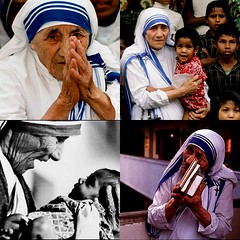 |
| Mother-Teresa-collage (Photo credit: Peta-de-Aztlan) |
Understanding Our Practices
To train ourselves in this way, we are required to practice in this way. In order to see somebody else's humanity, you must see your own. In order to have sympathy for somebody's predicament, you must have it for your own predicament. This is what takes off the labels, the blinders, the hatreds, and the things that separate us. There's an interesting story about a young boy having a discussion with his father. The boy says that he's going to write a story about himself. The father thought for a moment. Then he suggested to the young man that if he is going to write a story about his life that he should do so in a way that teaches others about their own lives. When we go through this process of training and working on ourselves we do that so we can translate that to others.
If you work with people who have mental illnesses you're going to hear a lot of labels. These are lables that are used by society and ourselves. You may hear bipolar. You may hear depressed. You may hear schizophrenic. These terms communicate some generalities that we can use to gain perspective about an individual's predicament. Each person that we work with will have their individual path from their disease to their recovery. The Buddha suggests that we all have our own path up the mountain. Our job with others is to erase these labels. We must strive to help others find their path. When we help others to remove the labels that they placed upon themselves they will begin to find their own path. In the end we do this because this helps to remove one of the most insidious labels that we encounter. This is the label of," mentally ill".
To train ourselves in this way, we are required to practice in this way. In order to see somebody else's humanity, you must see your own. In order to have sympathy for somebody's predicament, you must have it for your own predicament. This is what takes off the labels, the blinders, the hatreds, and the things that separate us. There's an interesting story about a young boy having a discussion with his father. The boy says that he's going to write a story about himself. The father thought for a moment. Then he suggested to the young man that if he is going to write a story about his life that he should do so in a way that teaches others about their own lives. When we go through this process of training and working on ourselves we do that so we can translate that to others.
If you work with people who have mental illnesses you're going to hear a lot of labels. These are lables that are used by society and ourselves. You may hear bipolar. You may hear depressed. You may hear schizophrenic. These terms communicate some generalities that we can use to gain perspective about an individual's predicament. Each person that we work with will have their individual path from their disease to their recovery. The Buddha suggests that we all have our own path up the mountain. Our job with others is to erase these labels. We must strive to help others find their path. When we help others to remove the labels that they placed upon themselves they will begin to find their own path. In the end we do this because this helps to remove one of the most insidious labels that we encounter. This is the label of," mentally ill".

No comments:
Post a Comment